
In this guide
Copper press fittings and soldered joints can both create sound copper-pipe connections when the system is correctly specified and the work is carried out competently. The useful question is not which method wins in every case, but which one best fits the pipework, site, tooling and scale of your job.
Pressing can make repeated jointing quicker and removes the need to apply a flame at the connection. Soldering brings familiar, often lower-cost entry tooling, but it needs controlled heat and careful workmanship. Looking at the whole installation helps you choose with confidence without treating either method as a shortcut.
How the two joints work
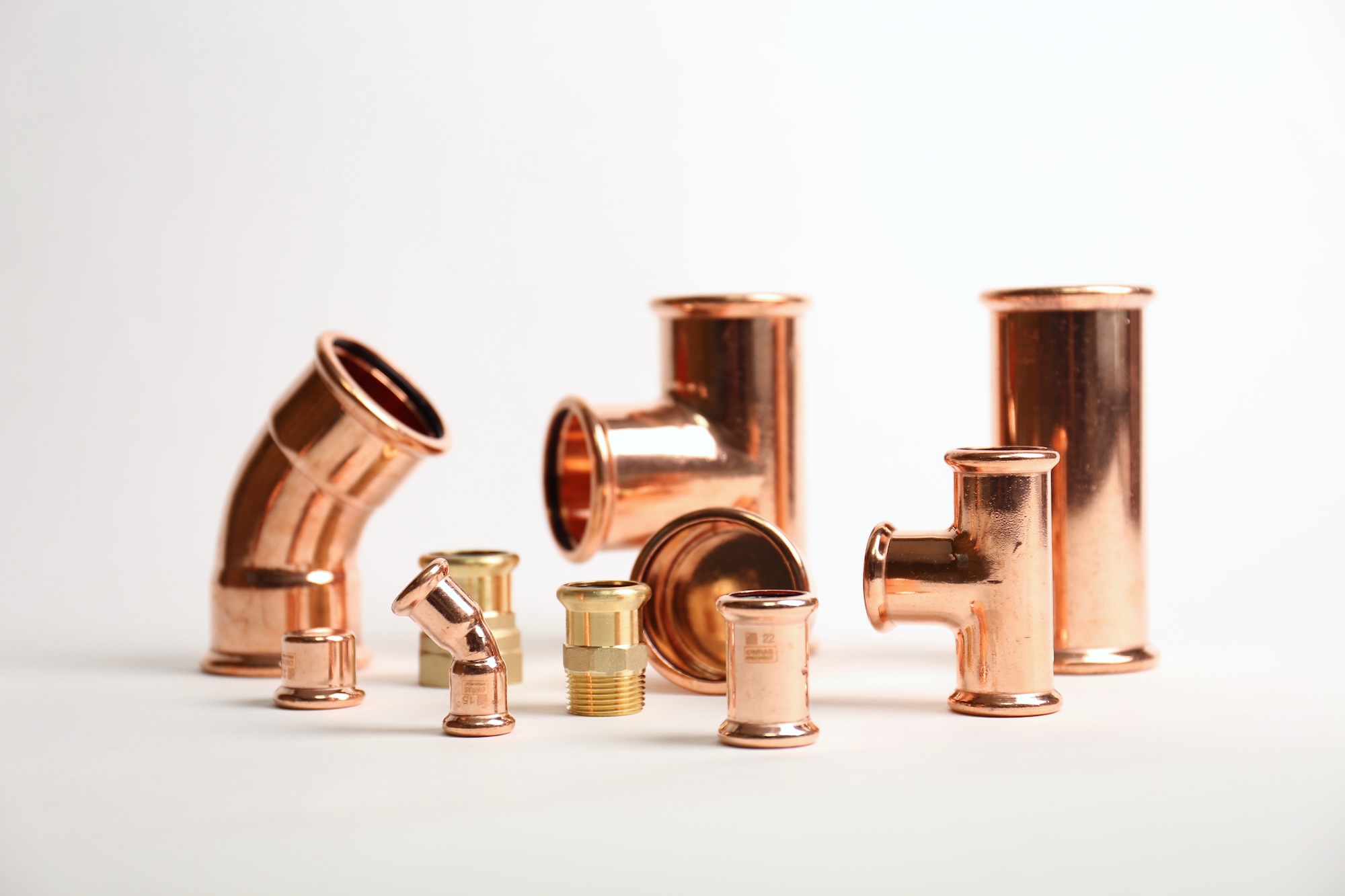
A copper press joint uses a purpose-made fitting with an internal seal. A compatible powered press tool and the correct jaw or profile mechanically form the fitting around properly prepared copper tube. The fitting, tube and tooling are one matched system, so similar-looking components should not be assumed to be interchangeable.
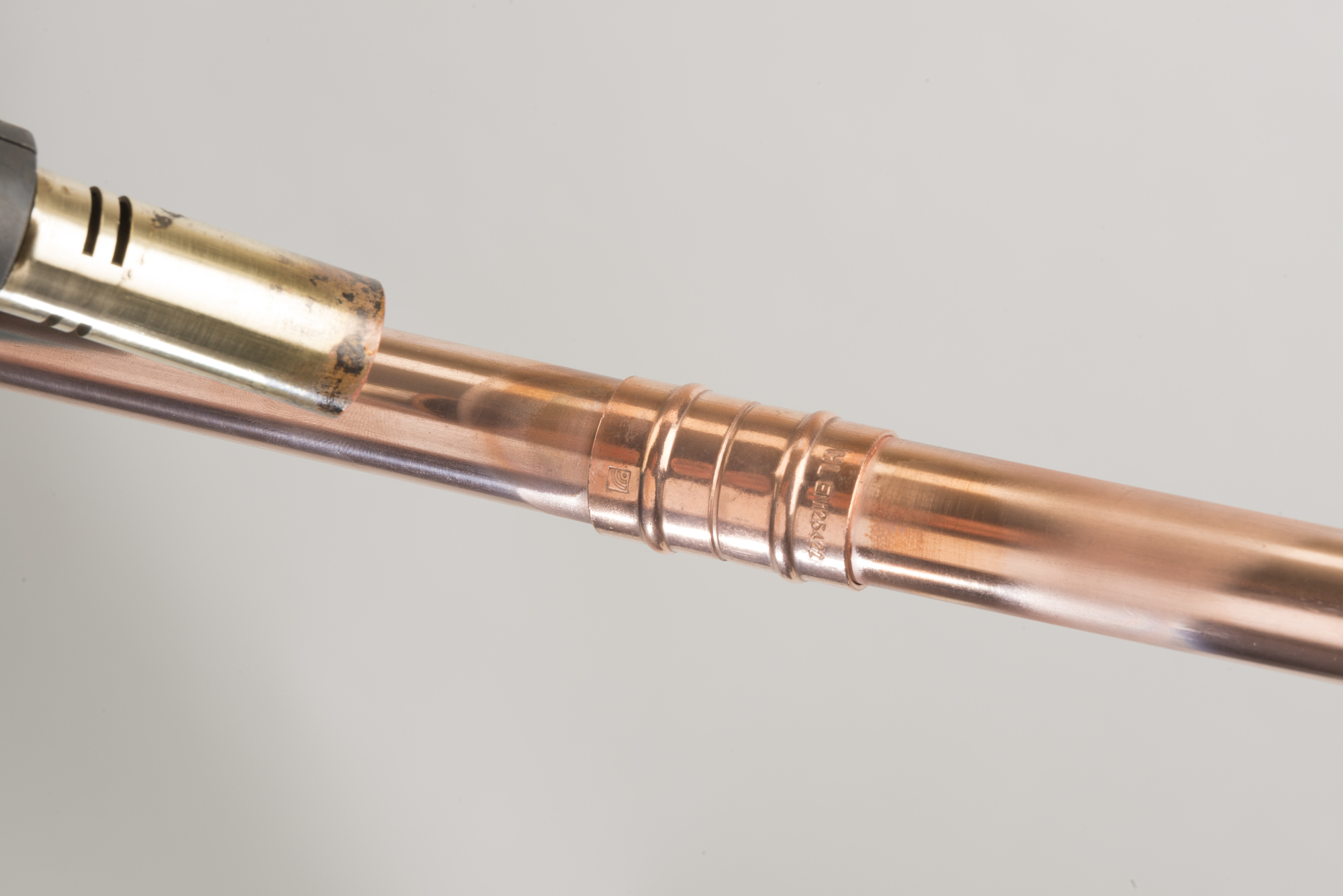
A soldered joint relies on heat and capillary action to draw suitable solder through the prepared gap between pipe and fitting. End-feed and solder-ring fittings both use this principle, but they handle the solder differently. End-feed fittings receive solder during assembly, while solder-ring fittings contain an integral ring. Each type still needs the products and method specified for that particular system.
Speed, preparation and workmanship
Pressing avoids the heating and cooling stage at each joint, so it can reduce jointing time where a job has many repeated connections. That benefit does not remove the need for sound tube preparation, full insertion, correct alignment, compatible tooling and the checks required by the fitting manufacturer.
Soldering usually involves more preparation, controlled heating, cooling and clean-up. The result depends on the pipe and fitting being suitable and on the person making the joint controlling the work correctly. A familiar technique is not automatically an easy one, and a quick press cycle is not proof that a joint has been formed correctly.
Tooling and whole-job cost
Press systems need a suitable press tool, the correct jaws or profile, and compatible fittings. That initial tooling commitment can be easier to justify across a larger installation with many joints than for a small one-off repair. If press is a suitable option for the specified system, the Copper Press Pipe Fittings collection provides a relevant range to consider.
Soldering tools and consumables often have a lower entry cost, although the preparation and time involved still contribute to the finished job. The fitting choice also matters. End Feed Fittings and Solder Ring Fittings are distinct options rather than interchangeable labels for the same product.
Compare total job conditions rather than one purchase price. Joint quantity, access, available tooling, labour time, competent installation and the consequences of rework can all change the balance. Neither method can be promised as the cheapest for every project.
Heat, access and site safety
A press joint is formed without applying an open flame at that connection. This can be a practical advantage around heat-sensitive surroundings or on sites where hot work is restricted. Press equipment still needs to be suitable, maintained and used with the controls required for the job, so flame-free does not mean risk-free.
Soldering introduces flame, hot materials, burns, fire and fume considerations. The correct products, ventilation, protection and current hot-work procedures depend on the site and application. Where those requirements cannot be confirmed or managed competently, the work needs professional assessment rather than an improvised approach.
Reliability and service life
Both methods are capable of durable service when the exact system suits the application and every joint is prepared, formed and checked correctly. Reliability depends on component compatibility, pipe condition, workmanship, environment and service conditions. It is therefore more useful to verify the system than to rank one joint type as universally stronger or longer-lasting.
A correctly selected method can still be undermined by incompatible components or poor execution. Avoid claims that a fitting is automatically leak-free, maintenance-free or guaranteed simply because it is pressed or soldered. Inspection and testing should follow the current requirements for the selected system and installation.
Compatibility checks before choosing
Check the current manufacturer documentation for the exact products being considered. A useful specification review includes:
- the copper tube material, dimensions and condition;
- the fitting range and permitted application;
- the required press profile and jaw, or the specified solder and flux;
- the seal material and service suitability where a press fitting uses a seal;
- the stated pressure and temperature limits;
- the relevant standards, warranty conditions and inspection or testing requirements.
A standards marking on its own does not prove that every fitting works with every copper pipe, tool or service. Suitability for potable water, heating, gas, concealed pipework or another application must come from the exact product evidence and the rules that apply to the job.
A practical decision checklist
Before settling on press or soldering, weigh the factors that affect this installation:
- the size of the project and number of joints;
- access around each connection;
- heat-sensitive materials and whether hot work is permitted;
- availability of compatible, serviceable tooling;
- installer competence with the selected system;
- manufacturer evidence for the pipe, fitting and intended service;
- whole-job cost, including time and possible rework;
- responsibility for inspection and testing.
For repeated work where compatible tooling is available and hot work is undesirable, press may be the more practical route. For a smaller job where a properly specified soldered system and competent installer are already in place, soldering may remain sensible. Those are project judgements, not universal rules.
If you cannot confirm the system compatibility or carry out the work safely, ask a competent plumbing professional to assess the installation. When you are ready to compare suitable connection options, explore the wider Copper Pipe Fittings range as a calm next step.