
In this guide
Understanding what happens inside a wet central-heating radiator makes it easier to choose suitable controls, compare a replacement and describe a heating problem clearly. The radiator is one part of a wider water circuit, so its warmth depends on the heat source, circulating water, valves and the way the whole system is set up.
From heat source to room
A wet radiator does not create heat. The system's heat source raises the temperature of the water, and a circulator moves that water along the flow pipework into the radiator. Energy passes from the water into the radiator body. The water leaves at a lower temperature through the return pipework and travels back through the circuit to be heated again.
This continuing flow allows the radiator to act as a heat emitter. If the wider system does not provide an adequate water temperature or flow, the radiator cannot deliver its intended output on its own.
How the radiator heats the room
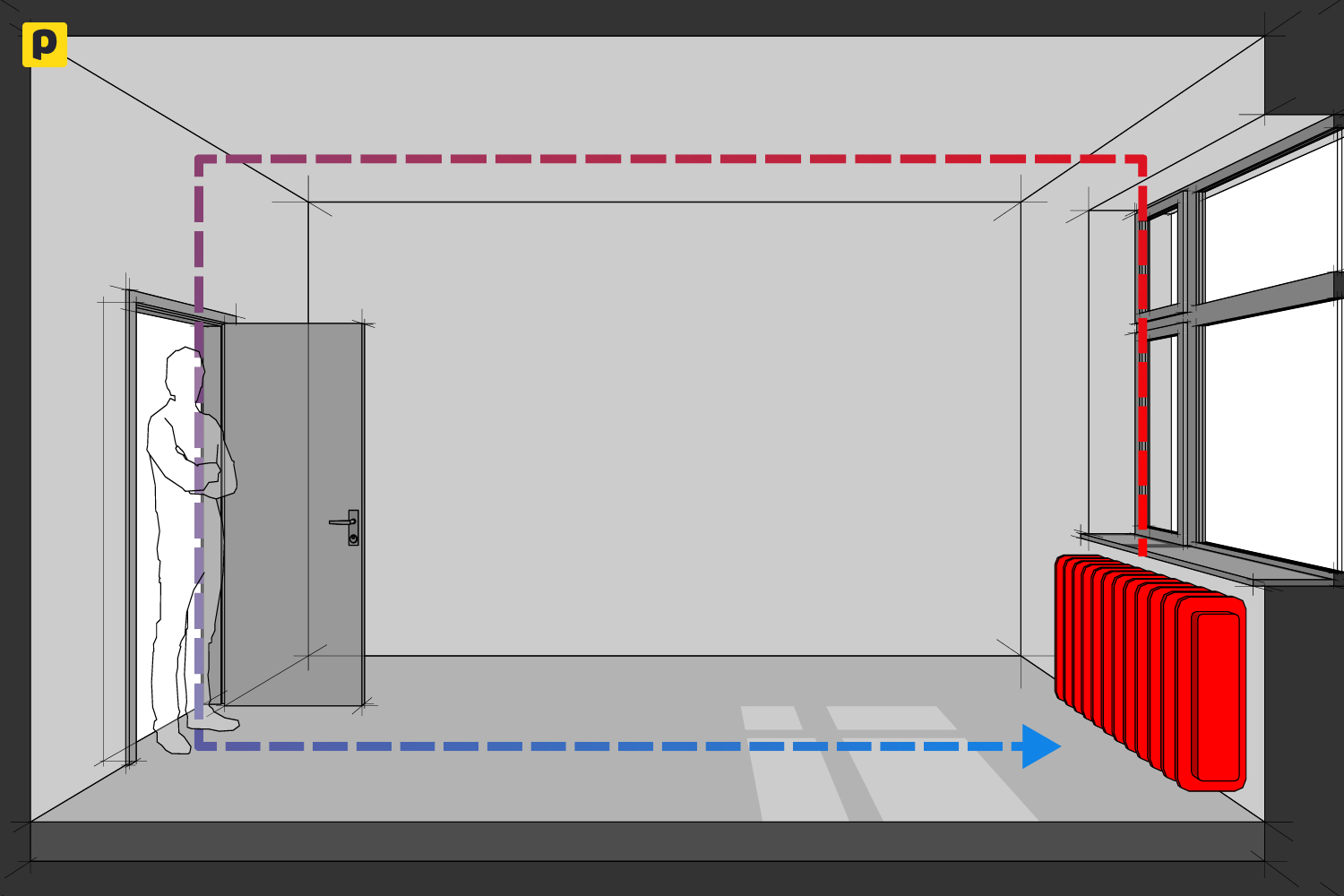
Three linked forms of heat transfer are involved. Conduction moves energy from the hot water into the radiator's metal. The warmed metal then heats the nearby air. That air becomes less dense and rises, while cooler air moves in to replace it, creating natural convection around the room.
The warm radiator surfaces also transfer energy to the room by thermal radiation. Both convection and radiation contribute, and the balance between them varies with radiator design. It is therefore misleading to describe every radiator as working only by convection or only by radiation.
Flow and return connections
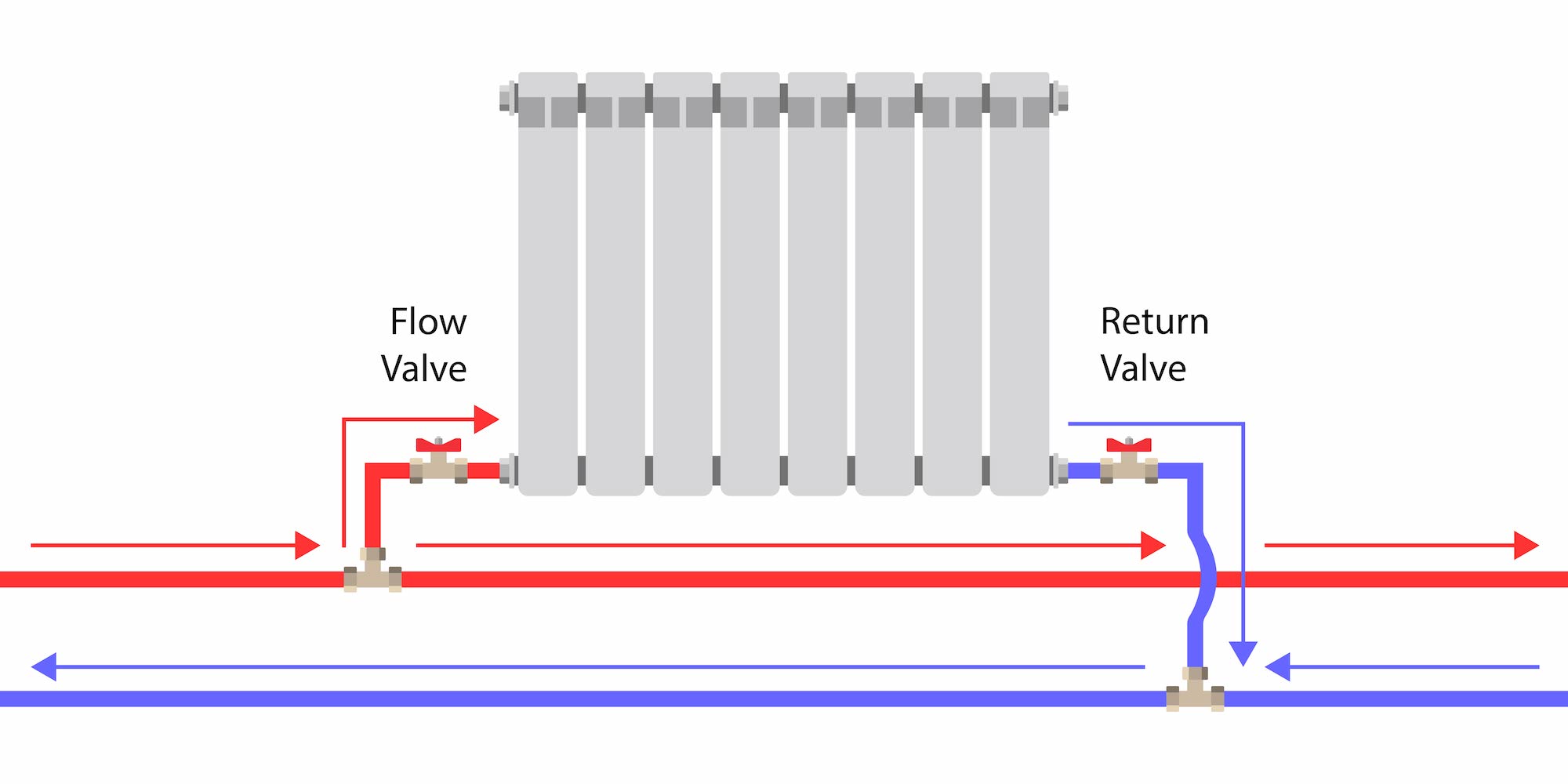
The flow pipe carries hotter water towards the radiator. The return carries cooler water away and back into the heating circuit. Water needs a path through both connections for the radiator to operate, so closing either valve interrupts that path. The appropriate valve settings still depend on the type of control and the balance of the system.
Do not assume that the left-hand connection is the flow and the right-hand connection is the return. Pipe routes, radiator designs and installations vary, so the direction must be established from the actual system rather than valve position alone.
What the two radiator valves do
One valve usually provides the room-side control. A manual valve is opened or closed directly. A thermostatic radiator valve, commonly called a TRV, senses the surrounding room air and adjusts the water flow as the selected level is approached. It does not set the temperature of the water produced by the heat source, and its setting is not a guarantee of one precise room temperature.
The valve at the other connection is commonly a lockshield. It is normally set during balancing so water flow is distributed appropriately between radiators across the system. It is not generally used as the day-to-day room control, and its correct position is specific to the installation rather than automatically fully open.
For a closer look at control types and installation checks, read Radiator Valves Explained - The Ultimate Guide.
Output, size and response
A radiator should be selected against the calculated heat loss of the room and the water temperatures at which the heating system is intended to operate. Published outputs also need to be compared at the stated test temperature difference. A figure quoted for one set of conditions should not be treated as the output under every system condition.
Several features influence useful output or how quickly a radiator responds:
- Overall dimensions and available surface area affect how much heat can be transferred.
- Extra panels or convector fins can add heat-transfer surface, but the stated output remains the useful comparison.
- Water temperature and flow affect the energy available to the radiator.
- Horizontal and vertical radiators mainly answer different wall-space and layout constraints, while dimensions and output still need checking.
- Cast iron generally warms more slowly and releases heat for longer because of its greater thermal mass. Aluminium generally responds faster. Steel is common, but no material is automatically the best choice for every room or system.
The practical route is to calculate the room requirement first, then compare compatible options. Which Radiator Do I Need? A Comprehensive Guide explains that selection process in more detail.
What you can safely observe
Simple, non-invasive observations can help you describe what is happening. You can note whether one radiator behaves differently from others, whether warmth appears uneven, whether a control seems to respond, and whether there is unusual noise, staining or visible leakage. Keep clear of hot surfaces and do not open, loosen or remove any component.
Those signs are clues, not diagnoses. Similar symptoms can arise from air, deposits, balancing, a valve, circulation or another system issue. A touch pattern or appearance alone cannot establish the cause. Radiator surfaces and system water can be hot, and sealed heating systems can be pressurised.
Visible leaks, repeated pressure loss, persistent imbalance, uncertain faults and any proposed alteration call for a competent heating professional and the applicable manufacturer instructions. Boiler, gas, electrical, draining, bleeding and valve-removal work sits outside a general explanation of radiator operation.
Choose a sensible next step
Before selecting equipment or arranging work, gather the information that determines a sound decision:
- Confirm that the appliance is a wet central-heating radiator rather than a direct electric heater.
- Obtain the room's calculated heat-loss requirement.
- Compare radiator output at the intended system temperatures and stated rating conditions.
- Check available dimensions, orientation, pipe centres and suitable controls.
- Arrange competent assessment for persistent faults, leaks, pressure loss, balancing, replacement or wider system changes.
With those checks in hand, you can compare radiators and controls on the factors that genuinely affect the room and the heating system, then move forward with much more confidence.