
In this guide
Identifying your home’s water system gives you a much better starting point for improving a weak shower, understanding poor tap flow or planning a plumbing upgrade. The useful clues are usually visible without taking anything apart: where the cold water comes from, whether hot water is stored, and what heats it.
This guide covers three common arrangements found in UK homes: gravity-fed systems, combi boilers and unvented cylinders. Homes can be altered or use a mixture of systems, so treat the clues as a practical way to narrow things down rather than a diagnosis from one feature.
A quick three-question check
Start with these three questions:
- Where does the cold water come from? It may come directly from the mains, from a storage cistern, or from a mixture of both depending on the outlet.
- Is domestic hot water stored? Look for a hot-water cylinder in an airing cupboard, utility space or similar location. Do not remove covers or adjust any controls.
- How is the water heated? A boiler may heat water on demand, heat a separate cylinder, or work alongside an immersion heater or another suitable heat source.
An electric shower, secondary appliance or previous conversion can complicate the picture. If the clues do not agree, record what you can see and ask a competent plumber or heating engineer to confirm the arrangement.
Gravity-fed water systems
A gravity-fed arrangement commonly has a cold-water storage cistern in the loft feeding a vented hot-water cylinder and some of the home’s outlets. One or more cold outlets may still be connected directly to the mains, so finding a mains-fed tap does not rule the system out.
Pressure in the stored-water pipework depends strongly on the vertical distance between the water level in the cistern and the outlet. This is often called the static head. More vertical head can provide more pressure, but the result at a tap or shower is also affected by pipe size, bends, restrictions and other outlets being used at the same time.
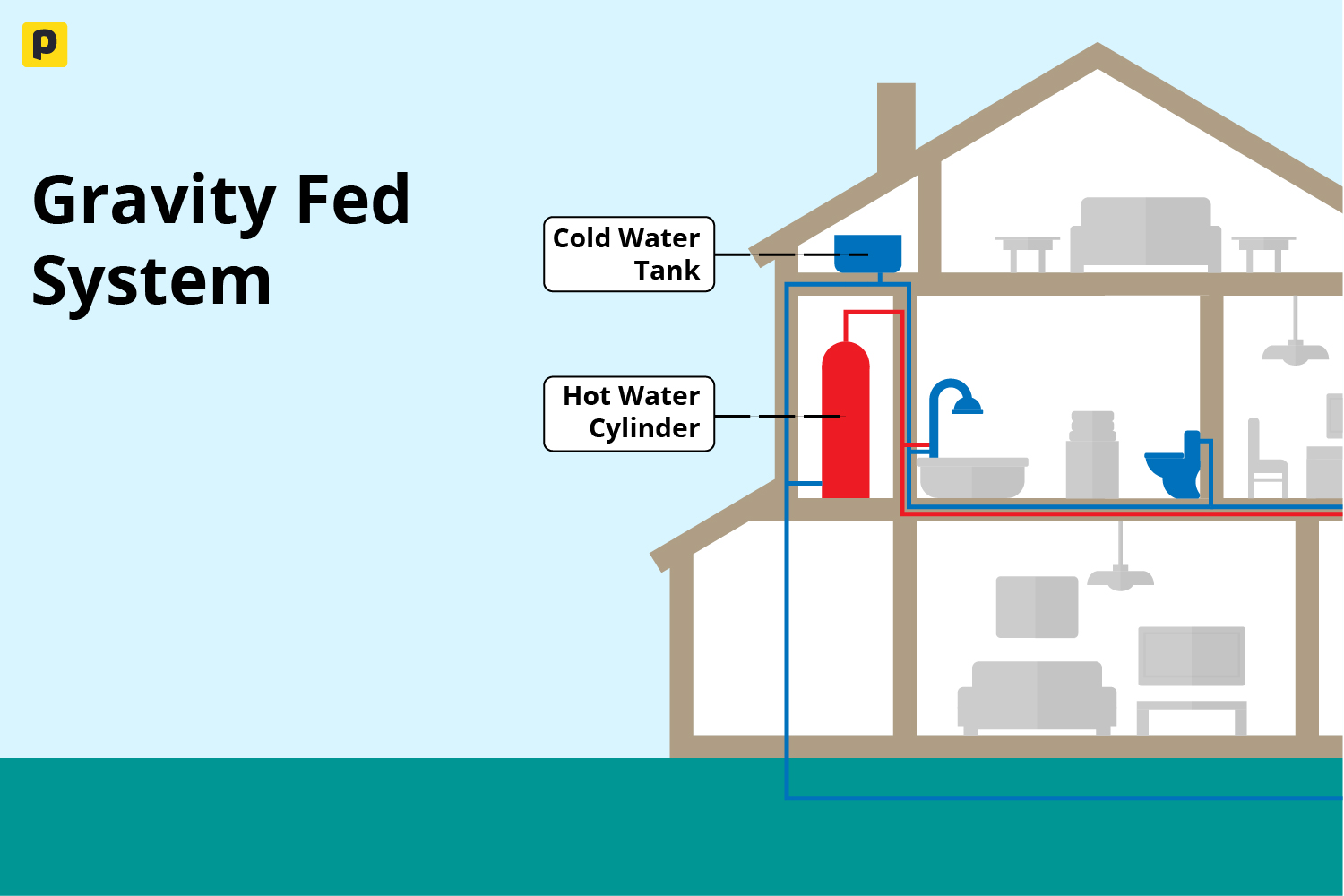
Advantages of a gravity-fed system
- Stored water: The cistern and cylinder provide a reserve rather than relying entirely on instant hot-water production.
- Straightforward components: The basic arrangement is familiar to many plumbers and can be practical where it suits the property.
- Flexible improvement options: An appropriate stored-water system may be suitable for a correctly specified shower pump after the supply, demand and product requirements have been checked.
Trade-offs to consider
- Lower pressure at some outlets: Upstairs showers and taps may have limited head, particularly when they sit close to the storage cistern.
- Space: A cistern and hot-water cylinder occupy loft and cupboard space.
- Stored capacity: The available hot water and cold storage must match the intended demand.
- Power and maintenance: Stored water may provide a reserve, but boilers, controls and any pumps can still depend on electricity. Tanks, cylinders and associated components also need appropriate maintenance.
Combi boiler systems
A combination boiler normally heats mains-fed domestic hot water as you draw it, so there is usually no separate domestic hot-water cylinder. That makes a combi arrangement relatively easy to recognise when you find a boiler but no hot-water storage.
The main benefit is space. Removing the need for a cylinder frees up a cupboard, and you do not deplete a fixed store of hot water in the same way as a cylinder. The trade-off is that delivery depends on the incoming mains supply and what the boiler can heat at that moment.
If several hot outlets run together, the available flow has to be shared. You may notice a weaker shower or a change in temperature even though the system works well with one outlet. If the boiler fails, there is normally no stored cylinder with an immersion heater to provide a separate hot-water backup, unless the property has another independent appliance.
A conventional shower pump intended for a gravity-fed stored-water system must not be fitted to a combi supply. Where the confirmed system and installation allow a specialist solution, use the manufacturer’s compatibility information and installer advice to narrow down Combi Boiler Compatible Shower Pumps.
Unvented cylinder systems
An unvented cylinder stores hot water supplied from the mains under pressure. It may be heated by a system boiler, an immersion heater or another suitable heat source. Unlike a traditional vented cylinder, it does not rely on a loft cistern to provide the domestic hot-water pressure.
You may see a substantial cylinder along with associated valves, controls and sometimes an expansion vessel. These are safety-critical parts of the system. Use them only as visible clues and do not adjust, isolate or bypass them.
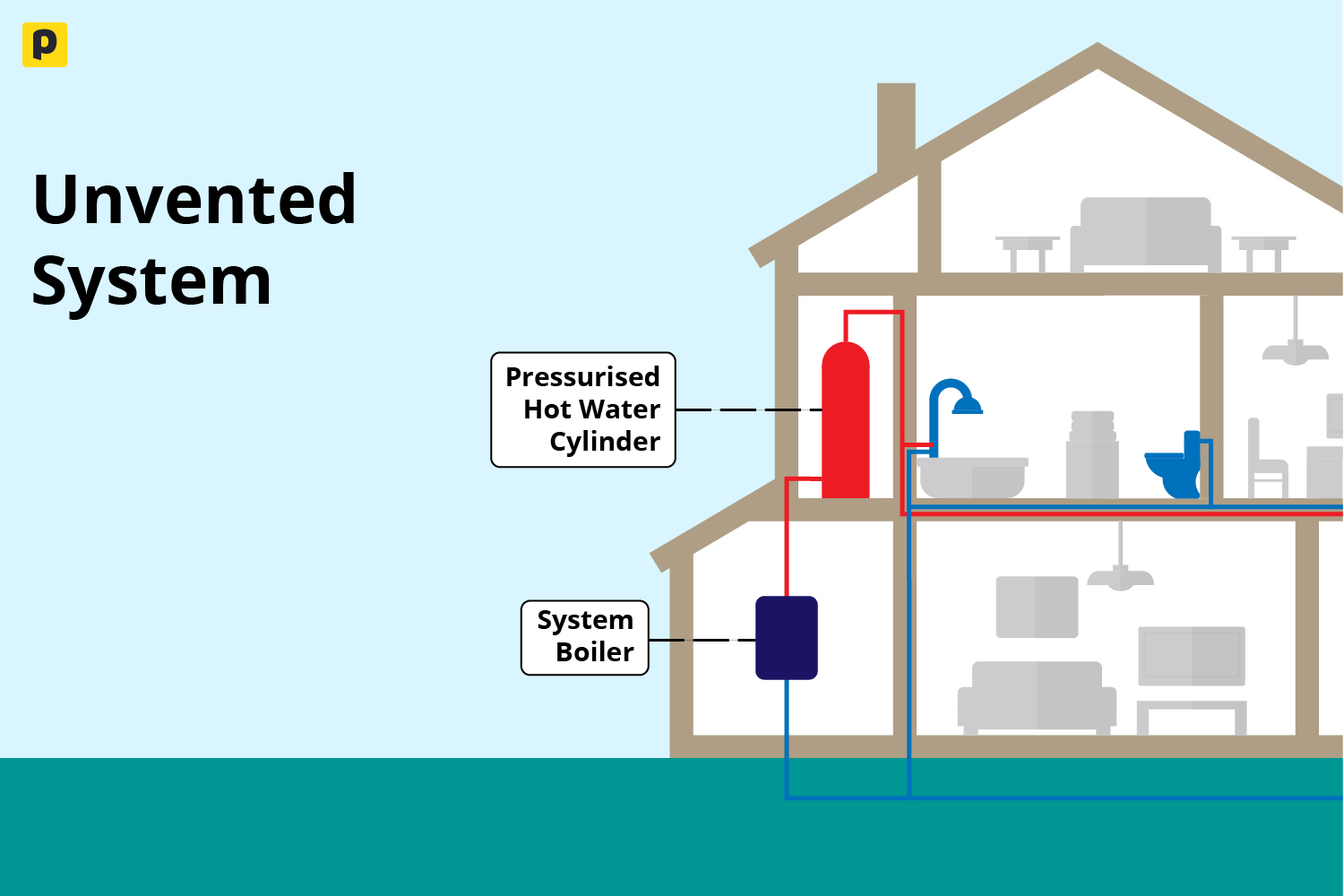
Advantages of an unvented cylinder
- Stored hot water: A correctly sized cylinder can support a household with greater hot-water demand.
- Strong-flow potential: Mains-fed stored water can serve several outlets effectively when the incoming supply, pipework and cylinder sizing are suitable.
- More than one heat source may be available: The exact arrangement can include a suitable boiler, immersion heater or another compatible source.
Trade-offs to consider
- Incoming supply matters: An unvented cylinder cannot make up for an inadequate mains supply on its own.
- Finite capacity and reheat: The cylinder stores a set volume, and recovery time matters after heavy use.
- Space: The cylinder and associated components require a suitable location.
- Specialist safety requirements: Installation and servicing of the cylinder and its safety devices require an appropriately competent professional.
Pressure, flow and simultaneous demand
Pressure and flow are related, but they are not the same thing. Pressure is the force driving water through the system. Flow is the volume that reaches an outlet over time.
A supply can have reasonable pressure but disappointing flow if a valve, narrow pipe, blocked fitting or several open outlets restrict the available volume. A larger pipe may pass a useful volume at modest pressure. What matters at a shower or tap is the combination of the two, along with the resistance in the pipework.
This distinction helps explain why system labels alone do not guarantee performance:
- A gravity-fed shower can be weak when there is little vertical head, even if the cylinder contains plenty of hot water.
- A combi can work well at one outlet but struggle when several hot taps share the incoming supply and boiler output.
- An unvented cylinder can offer strong flow only when the incoming mains, stored capacity, controls and pipework support the demand.
Before choosing equipment, compare behaviour at more than one outlet and at different times. A measured flow-rate check and a competent assessment give you a firmer basis than judging the system from how forceful one tap feels.
Common problems and what they can indicate
Weak flow on a gravity-fed system
Limited vertical head, restrictive pipework, partially closed valves or competing demand can all affect a stored-water outlet. A correctly specified pump may be one option, but the available storage, pipework, hot-water capacity and pump requirements all need checking first.
Poor combi performance
If both hot and cold mains-fed outlets are weak, the incoming supply or a restriction may be involved. If cold performance is satisfactory but hot delivery falls away under demand, the boiler and system arrangement need checking rather than assuming a general-purpose pump will solve it.
Poor unvented performance
An unvented cylinder depends on its incoming mains supply, controls, stored capacity and sizing. Do not adjust its safety components. A competent professional should investigate an unexpected change or performance below the system’s established norm.
For a fuller diagnostic framework, see Understanding Why Your Water Pressure Is Low.
Choosing a pump or higher-demand solution
Pump choice starts with the confirmed water system. The products used with an appropriate gravity-fed stored-water supply are not interchangeable with equipment designed for a mains-fed or combi arrangement.
- Gravity-fed stored water: A conventional shower pump may be suitable after the hot and cold supplies, head condition, number of outlets, storage and manufacturer requirements have been checked.
- Combi system: Use only a solution specifically compatible with the confirmed boiler and supply arrangement.
- Poor incoming mains performance: A suitably selected option from the Mains Inlet Booster Pumps range may be relevant, subject to current rules, supply conditions and installation requirements.
- Demand beyond a direct mains solution: A professionally designed arrangement using stored water, such as an accumulator or break tank, may need to be considered.
Direct mains boosting is regulated. Some products and arrangements are designed around a 12 litres-per-minute threshold, but that number must not be treated as universal permission for every installation. Confirm the current Water Supply requirements, the water undertaker’s conditions, the product instructions and the installer’s assessment before proceeding.
Confirm your system before making changes
You can collect useful information without dismantling anything:
- Note whether you can safely see a cold-water storage cistern.
- Check whether there is a separate hot-water cylinder.
- Record the make and model shown on the boiler and cylinder labels without removing covers.
- Compare hot and cold behaviour at more than one outlet.
- Note what changes when two outlets run together.
- Ask a competent plumber or heating engineer to confirm the arrangement before buying equipment or altering pipework.
Once you know you have an appropriate gravity-fed supply, Is It Worth Getting a Shower Pump? will help you weigh up the practical checks. You can then explore the Shower Pumps range with a much clearer idea of the system and application you need to support.