
In this guide
Compression fittings provide a practical way to join compatible pipe without applying a flame or solder at the connection. The familiar nut-and-olive design can be useful for accessible plumbing and heating work, but a reliable choice starts with matching the fitting, pipe and service. The material alone, or the fact that two parts appear to fit together, is not enough.
What a compression fitting is
A compression fitting is a mechanical tube connection. In the common Type A arrangement used with compatible tube, the main parts are the fitting body, a compression nut and a separate sealing element called an olive or compression ring. The tube also forms part of the finished joint and must be suitable for the fitting.
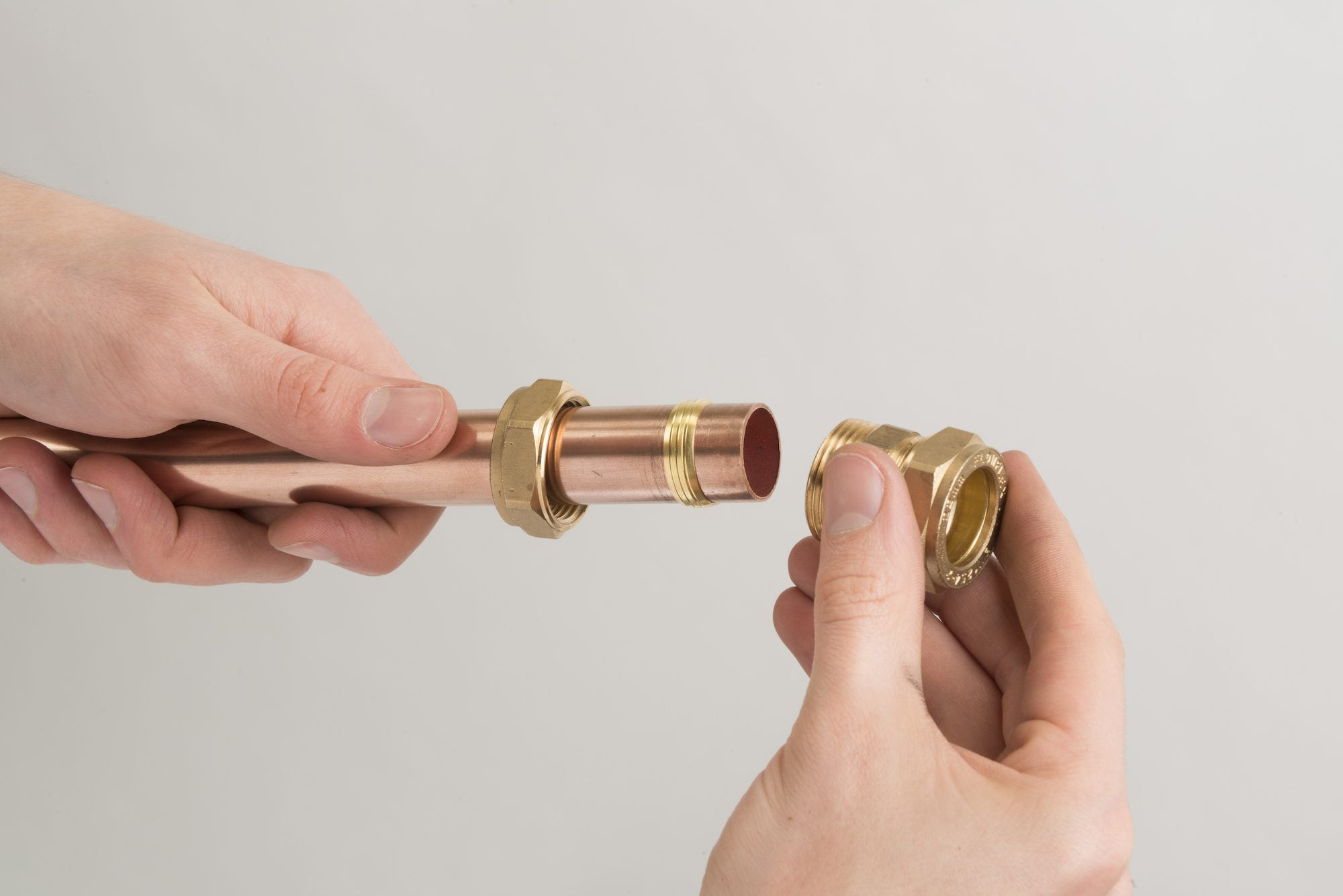
This three-part description is useful for understanding many familiar fittings, but it is not a rule for every product sold as compression. Type B fittings use a different, manipulative arrangement, while some proprietary systems for plastic pipe use grippers and seals rather than the same nut-and-olive mechanism.
How the joint is formed
For a compatible Type A fitting, the prepared tube is inserted fully to the fitting stop. Tightening the nut by the manufacturer’s specified method draws the olive into the fitting seat. The olive is compressed around the tube, creating the gripping and sealing interface between the tube, olive and body.
The nut thread supplies the clamping force. It is not itself the pipe seal. That distinction matters because PTFE tape or jointing compound is not a universal remedy for a compression joint. Whether any additional material is allowed depends on the exact fitting and its instructions.
The completed connection must be inspected and tested under the procedure appropriate to the system. There is no single number of turns, tightening torque or test routine that applies to every fitting size, tube and service.
Why compression can be useful
A suitable compression fitting creates the joint without a flame or soldering at that connection. This can be helpful where access is limited or where introducing heat would be inconvenient. Approved assemblies can also be made with compact hand tools, which makes them practical for many repairs and alterations.
Heat-free does not mean hazard-free, however. Pipework still needs to be isolated and depressurised where required, and the installer still needs the correct tools, clean components, suitable access and an appropriate test. Water, electrical equipment, hot systems and regulated services each bring their own risks.
Apparent simplicity should not be confused with universal DIY suitability. A straightforward accessible water-pipe connection is not the same task as work on gas, a live system or another regulated service.
Compatibility comes before convenience
Start with the fitting manufacturer’s current product information, then check the pipe maker’s requirements where relevant. The important details include the fitting design, pipe material, outside diameter, dimensional standard and hardness, as well as the service, operating limits, approvals and installation environment.
Copper, PEX, polybutylene, MDPE and stainless-steel tube are distinct materials and systems. Many compression fittings can be used with compatible plastic pipe, but not all of them can. The approved combination may require a particular support insert, olive, insertion depth or preparation method. Parts should never be mixed simply because their nominal size or appearance seems similar.
- Confirm that the fitting is approved for the exact pipe material and outside diameter.
- Check whether the pipe needs a specified support insert or sealing component.
- Verify the intended service, temperature and pressure limits in the current product data.
- Confirm any requirements for potable water, heating, gas, burial or concealed installation.
- Use the fitting and pipe manufacturers’ preparation, tightening and testing instructions.
Materials, shapes and services
Brass and other copper alloys are common fitting-body materials, but the word brass does not establish suitability on its own. Material, design, approval and operating limits all work together. A chrome-plated fitting has a different finish, but the finish does not by itself change the underlying connection requirements.
Shape describes the job a fitting performs in the pipe layout. Couplings join straight runs, reducers connect approved different sizes, elbows change direction, tees create a branch, stop ends close an approved pipe end, and adaptors connect to another compatible connection type. Our guide to Types of Compression Fittings Explained covers these distinctions in more detail.
Do not infer an application from shape or material alone. Potable-water, heating, gas, underground, concealed and industrial uses can have different requirements. The exact product data and applicable rules must confirm where a fitting may be used.
Demountable does not always mean reusable
A compression connection may be capable of being dismantled, but that does not make every component suitable for another assembly. Tightening deforms the olive around the tube. Once released, the olive may remain fixed in place, and the tube, nut or fitting body may show marking, distortion, corrosion or other damage.
There is no universal instruction to replace only the olive and reuse everything else. Inspecting the joint and choosing replacement parts must follow the fitting manufacturer’s remedial guidance. Where fresh approved components or a new section of tube are specified, use them.
Safe installation and testing
Keep the work controlled from the start. Isolate and depressurise the system as required, confirm that the pipe and fitting match, and use clean, undamaged tube and components. Prepare the tube and seat it fully, then tighten the assembly only by the selected manufacturer’s method.
After assembly, inspect, test and commission the joint under the procedure that applies to the system. A connection that looks tidy has not yet proved that its components, preparation or performance are correct. For practical assembly detail, read How To Install Compression Fittings.
Gas work and other regulated or higher-risk services require an appropriately registered or competent installer. If the pipe material, service or existing joint cannot be identified confidently, pause the work and get the system assessed before selecting a fitting.
Choose the fitting around the job
The useful question is not simply whether a compression fitting will go onto the pipe. It is whether that exact fitting, sealing arrangement and tube are approved to work together in the intended service, and whether the connection can be prepared, tightened and tested correctly.
Browse the Compression Fittings collection once you know the pipe material, outside diameter and service requirements. Those checks make it much easier to narrow the range confidently and choose a suitable next step.