
In this guide
The right shower pump can turn weak, uneven flow into a more practical showering setup, but the first choice is not a brand or bar rating. It is whether your system needs one water supply boosted or both. That is the basic difference between single- and twin-impeller shower pumps.
Impeller count is only the starting point. Your hot and cold water arrangements, natural flow, head condition, outlet demand and the pump manufacturer's permitted applications all need to line up before you choose.
First, identify what is actually weak
Start by checking where the problem appears. Is the hot flow weak while the cold side performs well? Are both sides poor at the shower? Does performance change when another tap or outlet is opened? These observations help separate a one-supply problem from a wider system issue.
It is also important to identify how your home supplies hot and cold water. A gravity-fed arrangement behaves differently from a mains-fed system, combi boiler, unvented cylinder or another stored-water setup. A shower pump that suits one arrangement may be unsuitable for another, so treat the system type as a decision-critical check rather than a minor detail.
Pressure and flow are related, but they are not the same thing. A quick flow measurement can show how much water reaches an outlet, while the system layout and height relationships help determine how that flow is produced. Together, these checks give you a much better basis for choosing a pump.
What is a single-impeller shower pump?
A single-impeller pump boosts either the hot or the cold water supply. Depending on the pump and the system, it may serve one outlet or several outlets supplied by that feed.
A common situation is a stored hot-water supply that is noticeably weaker than the cold side. Boosting the hot feed may help bring the two sides closer together, but matching performance is not simply a case of choosing the same bar figure. The mixer, supply arrangement, head condition, outlet demand and manufacturer's instructions must all be checked so that the chosen pump is suitable for the complete setup.
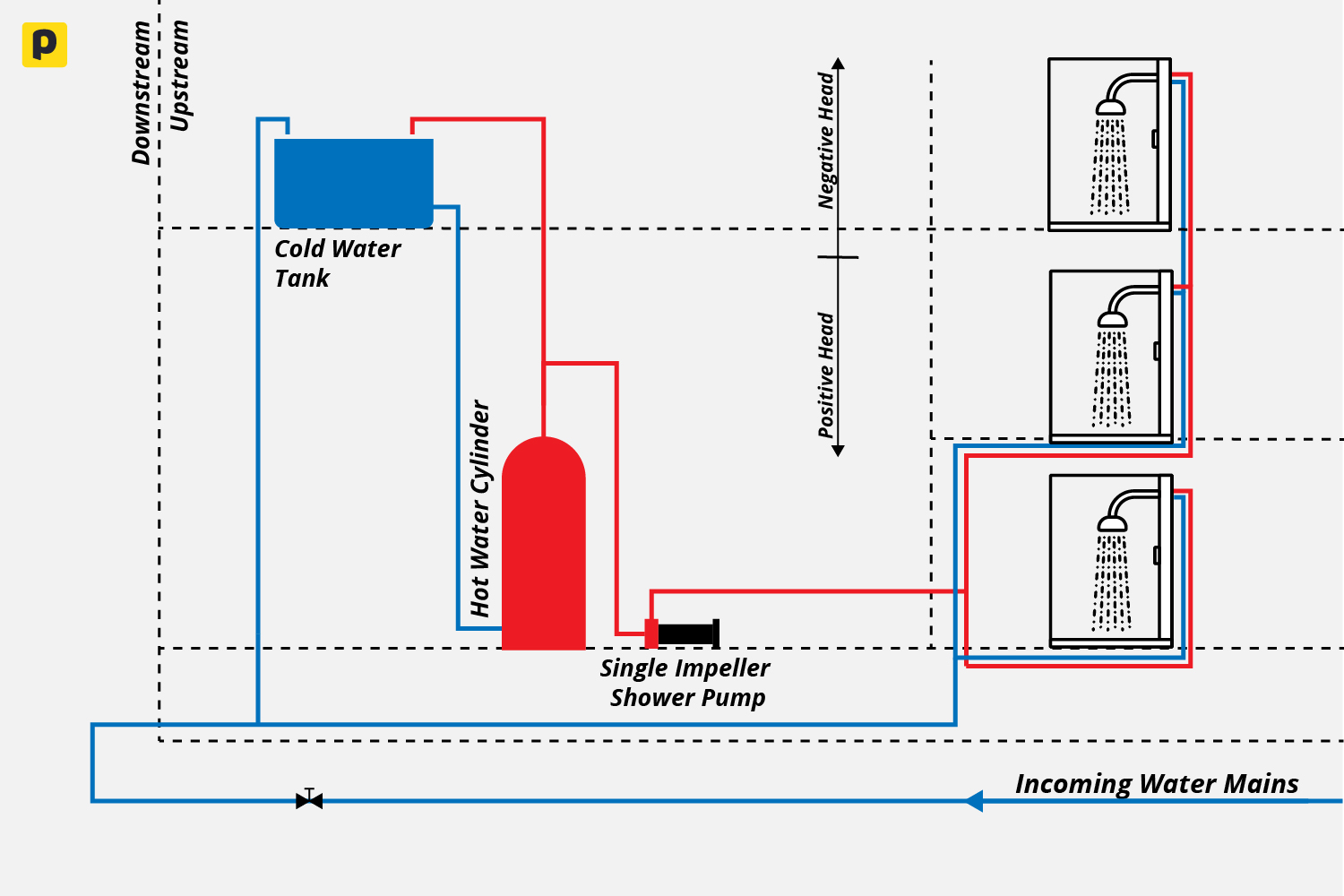
Where hot and cold feeds are too far apart for a conventional twin-pump position, two correctly specified single pumps may sometimes form part of the design. That is a system-design option for a competent installer to assess, not a like-for-like substitute that will suit every home.
If your checks show that only one compatible supply needs boosting, you can compare Single Impeller Shower Pumps.
What is a twin-impeller shower pump?
A twin-impeller pump boosts both the hot and cold supplies. In a compatible stored-water system, one impeller handles the hot feed and the other handles the cold feed, creating a paired boosted supply for the intended outlets.
This can be the more suitable approach when both sides need assistance, particularly where balanced hot and cold delivery matters at a mixer shower. It does not automatically guarantee perfect balance or make every system compatible. Dedicated feeds, pump location, pipework, natural flow, head condition and simultaneous demand still need to meet the selected manufacturer's requirements.
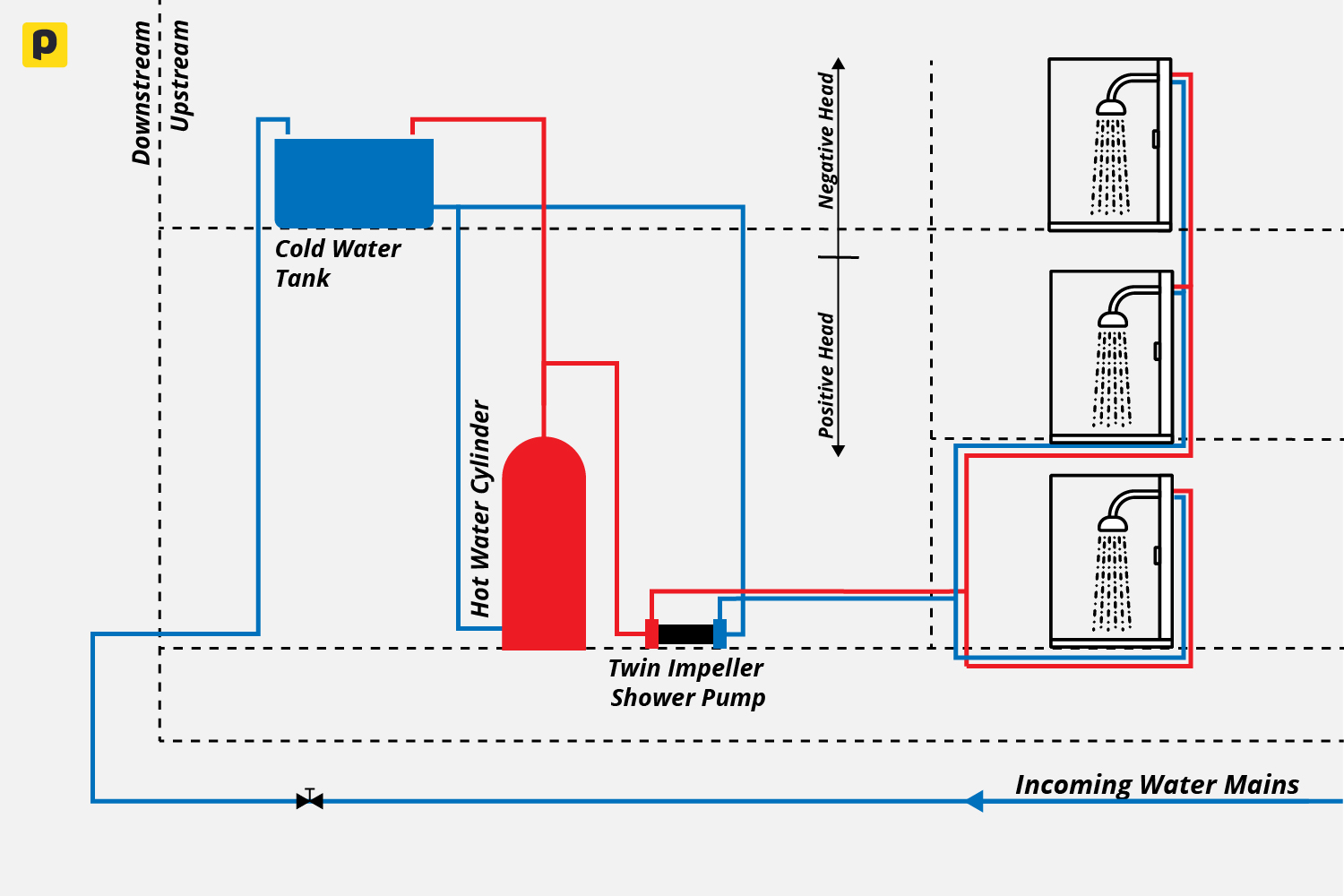
If both compatible stored supplies need boosting, compare the available Twin Impeller Shower Pumps after completing the checks below.
Positive head, negative head and pump activation
A positive-head pump relies on enough natural, gravity-driven flow through the outlet to activate it. If that trigger flow is not available, a universal or negative-head design may be needed, provided it is suitable for the rest of the system.
Do not diagnose the head condition from one symptom or one outlet reading. Manufacturers may state a minimum activation flow for a particular range, and figures such as 2 litres per minute may appear in product guidance, but that does not create a universal definition for every pump. Check all intended outlets and the instructions for the exact model.
For a fuller explanation of the layout and checks involved, read What Is A Negative Head or Positive Head Pump?.
How to decide which type you need
- Identify every affected outlet. Note whether the issue is limited to one shower or appears at several taps and showers.
- Measure natural flow. Test every outlet you intend to pump, checking hot and cold separately where possible. Repeat the check while other outlets are running if simultaneous demand matters. Our guide explains How To Measure Your Flow Rate.
- Decide which supplies need assistance. One weak, compatible feed may point towards a single-impeller design. Hot and cold feeds that both need boosting may point towards a twin-impeller design.
- Confirm the water-system arrangement. Check whether the supplies are stored, gravity-fed or mains-fed and whether the intended pump is permitted for that arrangement.
- Check head condition and activation requirements. Natural flow must be sufficient to activate a positive-head pump. Where it is not, a suitable universal or negative-head pump may be required.
- Match the pump to the complete job. Consider simultaneous demand, permitted outlets, pipework, location, noise, controls, electrical requirements and access for servicing.
There is no universal flow-rate figure that makes every shower acceptable or proves that a particular pump will work. Compare your measurements with the requirements of the intended outlet and the current instructions for the exact pump being considered.
Can a shower pump be connected to the mains inlet?
Do not assume that a conventional shower pump can connect directly to every mains-fed supply, combi-boiler or unvented-cylinder system. The pump's approved applications and the complete water-system design must be checked before any connection is planned.
In England and Wales, installing a pump or booster that draws more than 12 litres per minute when connected directly or indirectly to a supply pipe is notifiable to the local water undertaker and requires consent. Requirements can differ elsewhere, so check the applicable local rules as well as the manufacturer's instructions.
If a conventional shower pump is unsuitable, a competent assessment may identify a break tank, accumulator or another booster arrangement as part of a compliant design. These are different system solutions, not automatic alternatives that can be selected from one flow reading.
Other practical checks before choosing
- Outlet demand: establish which showers, taps or other outlets may run together.
- Pump location: confirm that the proposed position complies with the manufacturer's installation requirements and remains accessible for servicing.
- Pipework and dedicated feeds: check that the supply route suits the intended single- or twin-impeller arrangement.
- Mixer compatibility: make sure the hot and cold supplies can work safely and effectively through the intended shower or tap.
- Noise: consider where the pump will operate and how its location may affect nearby rooms.
- Electrical and plumbing work: arrange competent installation in line with current instructions and applicable requirements.
Single vs twin impeller pump costs
Twin-impeller pumps commonly contain more components and may cost more to buy than a comparable single-impeller pump. The unit price is only part of the comparison, however. Installation, controls, pipework changes, location, servicing access and correct sizing all affect the total cost of the job.
If only one compatible supply needs boosting, a suitable single pump may be the more focused option. If both supplies need boosting, choosing a single pump purely because it costs less would not address the full requirement. Correct system fit is more important than the lowest purchase price.
Your final decision checklist
- What type of hot and cold water system do you have?
- Which outlets are affected?
- Is the weakness on the hot side, cold side or both?
- What natural flow do you measure at every intended outlet?
- Will multiple outlets run at the same time?
- Is the arrangement positive head, or is a universal or negative-head design needed?
- Does the manufacturer permit the pump for your system and intended outlets?
- Are notification or consent requirements relevant to the proposed connection?
- Is the location suitable for pipework, noise, servicing and electrical installation?
- Has a competent installer confirmed any uncertain compatibility or mixer-balance points?
Choose with confidence
The simple rule is one impeller for one supply and twin impellers for hot and cold, but a confident choice comes from checking the complete system. Measure the flow, identify the affected feeds, confirm the head condition and make sure the intended pump is approved for the arrangement.
Once those details are clear, explore the wider Shower Pumps range or speak to a competent installer about the most suitable next step for your home.